Managing Your Wedding Guest List Without Losing Your Mind
Practical tips for building and managing your wedding guest list — from the first draft to final headcount. How to handle tricky situations and stay organized.
Key Takeaways
- Start with your A-list (must-invite), then B-list, then C-list
- Use a single tool for your guest list — avoid scattered spreadsheets
- Track RSVPs in real time so you always know your headcount
- Export your final guest list as CSV for your caterer and venue
Posted by
 Marwan
Related reading
How to Share Your Wedding Invitation on WhatsApp (the Right Way)
A practical guide to sharing your digital wedding invitation via WhatsApp — including message templates, group etiquette, and tips for making it personal.
When to Send Wedding Invitations: The Complete Timeline
A month-by-month guide for when to send save-the-dates, invitations, and RSVP reminders — with adjustments for destination and holiday weddings.
Last-Minute Wedding Invitations: It's Not Too Late
Short on time? Learn how to create and send beautiful wedding invitations at the last minute — without the panic or the paper waste.
The guest list. It's the single most politically charged document you'll ever create, and somehow nobody warns you about it. Your mom wants to invite her entire office. Your partner's dad has 40 cousins. Your venue fits 120 people. And you're trying to keep everyone happy without tripling your catering budget. According to The Knot's 2025 data, the average wedding has 130 guests, but the average couple's initial draft list has over 200 names on it. That gap between “who we want” and “who actually fits” is where the stress lives. Deep breath. Here's how to approach it without losing your mind (or your relationships).
Should Each Partner Make a Separate Guest List First?
Absolutely — and here's why. Before you combine anything, each partner should make their own list independently. Don't discuss it yet — just write down everyone you'd want there if money and space were no object. Family, friends, colleagues, that couple you met on vacation who became weirdly close. Get it all down. Then compare. You'll immediately see the overlap and the outliers. Some names will be obvious must-haves. Others will need a conversation. That's normal and healthy — it's better to have that conversation early than to fight about it when invitations are about to go out.
How to Split the List Fairly
A common approach is to divide the guest list into thirds: one third for Partner A, one third for Partner B, and one third shared (mutual friends, both families' overlapping social circles). If one partner has a significantly larger family, adjust the split accordingly — the goal is equity, not strict equality. Another approach is to give each set of parents a fixed allocation if they are contributing financially to the wedding. Whatever method you choose, agree on it before you start merging lists. Having clear ground rules prevents the “but my mom really wants her hairdresser there” conversation from spiraling into an argument about priorities and fairness at 11 PM on a Tuesday.
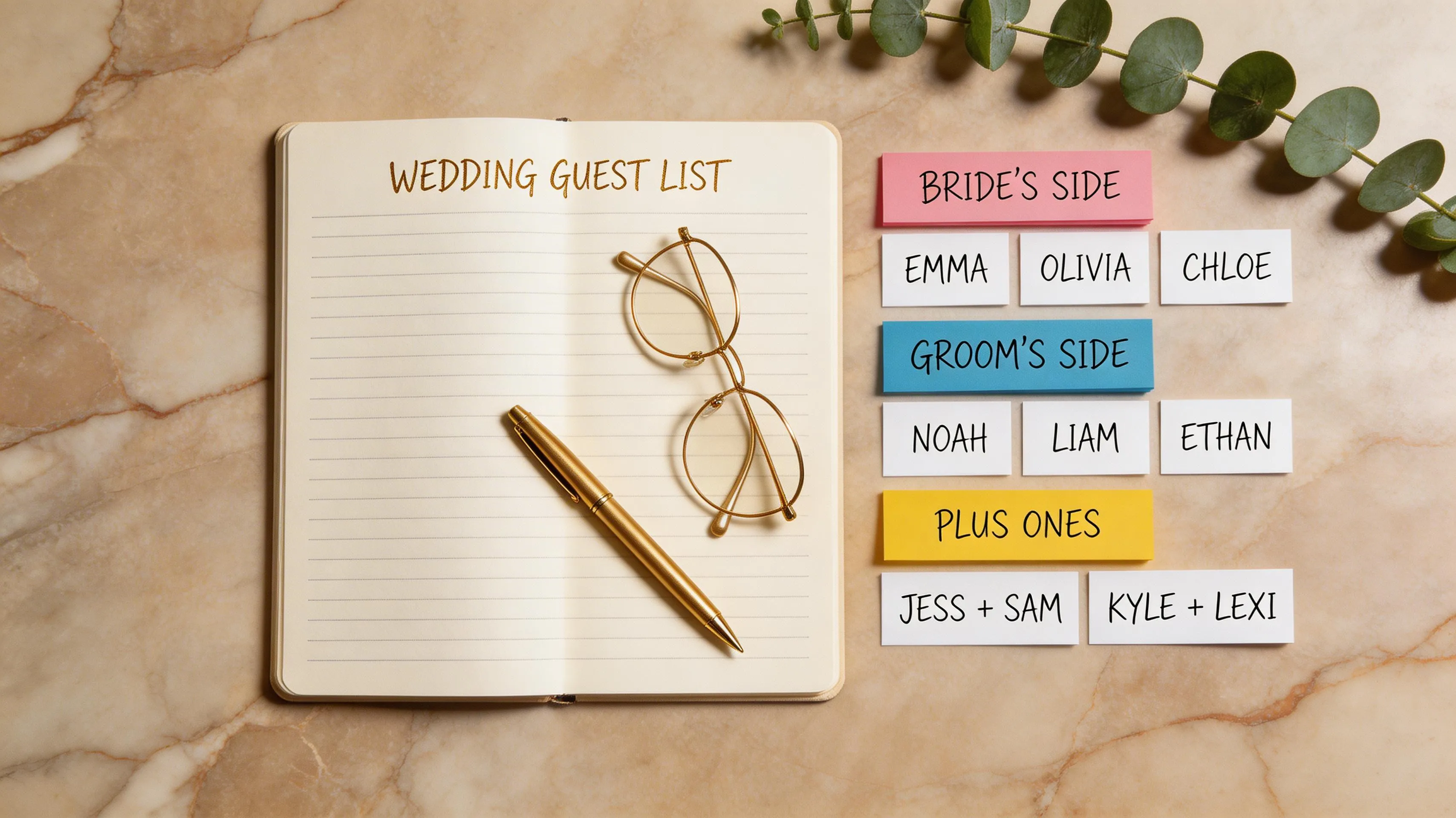
What Is the A-List / B-List Strategy and Does It Actually Work?
This sounds cold, but it's actually the kindest approach — and wedding planners recommend it universally. Your A-list is people you absolutely cannot imagine the day without. Your B-list is people you'd love to have but could understand not inviting due to space. Send A-list invitations first. As declines come in (and they will — expect 15–20% on average according to WeddingWire), you can extend to the B-list. The math works out well: if you have 120 A-list spots and expect 15% declines, that frees up about 18 seats for B-list guests. Send those B-list invitations promptly after declines arrive so those guests still have plenty of notice. This is where digital invitations really shine — with paper, you can't easily send a second wave without it feeling like an afterthought, since a late-arriving paper invitation practically screams “you weren't our first choice.” With a digital link, you simply share it with additional guests and nobody knows they weren't in the first batch. No bruised feelings, no wasted stationery — just open your dashboard, add the new guests, and share the link.
How Do You Handle Tricky Guest List Situations?
Kids or No Kids?
If you're having an adults-only wedding, state it clearly on the invitation: “We respectfully request an adults-only celebration.” Don't leave it ambiguous. Some guests will be relieved (date night!). Others will need to arrange childcare. Either way, they need to know early. As Brides magazine points out, clarity is kindness — don't make your guests guess.
Plus-Ones
The general rule: couples who are married, engaged, or living together get invited as a unit. Single friends in serious relationships should get a plus-one. Casual daters? That's your call, but be consistent. If one single friend gets a plus-one, they all should. Inconsistency is how feelings get hurt. On SaidVows, you can configure plus-one permissions per guest, so each person sees the appropriate options on their RSVP form. If Sarah gets a plus-one, she sees the option to add a name. If Mark doesn't, the option simply doesn't appear — no awkward “sorry, you can't bring someone” moment.
Divorced Parents and Blended Families
This is more common than ever and doesn't have to be awkward. List each parent (and their partner, if applicable) separately on the host line. Digital invitations make this easy to customize per template section — no envelope-stuffing politics required. If your parents aren't on great terms, you can even send personalized messages alongside the invitation link when sharing it individually.
Colleagues and Work Friends
This is where many couples get stuck. The rule of thumb: if you wouldn't grab dinner with them outside of work, they probably don't need a wedding invitation. But if you do invite some colleagues, be thoughtful about who hears about it at the office. Inviting three people from a five-person team creates tension. Either invite the whole group or keep work invitations to close friends who happen to be coworkers. If your workplace is small enough that word will spread regardless, a brief heads-up to the uninvited is a kind touch — “We're keeping it really small” is an honest and perfectly acceptable explanation that most people will understand without any hard feelings.
How Do You Trim the Guest List Without Hurting Feelings?
At some point, you will need to cut names. It's one of the least fun parts of wedding planning, but there are strategies that make it less painful. Start with clear criteria: Did we both independently put this person on our list? Have we spoken to them in the last year? Would we invite them to a small dinner party? If the answer to all three is no, they probably don't need to be at your wedding. Apply the same criteria to everyone — no exceptions — so it feels fair rather than personal. According to WeddingWire, the most common categories that get trimmed are parents' work friends, distant cousins you haven't seen since childhood, and college friends you've lost touch with. It's okay to acknowledge that some relationships have drifted — your wedding guest list doesn't have to be a census of everyone you've ever known.
What's the Best Way to Stay Organized?
However you manage your list, keep it in one place. A shared spreadsheet works, but SaidVows's built-in guest management dashboard works even better — it tracks invitations sent, RSVPs received, meal choices, dietary needs, and plus-ones all in real time. You can export everything as a CSV when your caterer needs the final numbers. No toggling between three apps and a crumpled napkin with names on it.
What Your Dashboard Should Track
A good guest management system tracks more than just “attending” or “not attending.” You need: invitation status (sent, opened, RSVPed), attendance response, plus-one details (name and meal preference), dietary restrictions and allergies, table assignment (if you're doing assigned seating), song requests, and any custom questions you asked. SaidVows captures all of this automatically through the RSVP form, so you never have to manually enter data. When your caterer asks for the final count by meal choice, you export one CSV. When your DJ asks for song requests, you export another. The data is always current, always organized, and accessible from any device. Equally important is setting a final headcount date and sticking to it — your caterer and venue need those numbers, and every day past the deadline costs you stress and sometimes money. Give yourself a buffer: set your RSVP deadline 3–4 weeks before the wedding and your internal “numbers are locked” date at 2 weeks before. Check our pricing plans to see which guest management features are included at each tier.
What Is the Ideal Guest List Size for Different Budget Levels?
Budget and guest count are inextricably linked — you cannot plan one without the other. According to The Knot's 2025 data, the average per-guest cost at a wedding ranges from $100 to $300 depending on the region and formality level. That means the difference between inviting 100 guests and 150 guests is $5,000–$15,000 in catering alone — before you factor in favors, table settings, and additional seating. Run the numbers early: multiply your estimated per-head cost by your guest count, and make sure the total fits within your overall budget. If it does not, you have two choices: cut the list or cut costs elsewhere. Most couples find it easier to trim the list than to downgrade the food or venue. The guests who are there will have a better time at a well-funded 100-person wedding than a stretched-thin 200-person one. Use SaidVows's guest dashboard to track your numbers in real time as RSVPs come in — you will know exactly where you stand at every stage, making budget adjustments straightforward rather than a guessing game. And remember: the guest list is a living document. It will change multiple times before your wedding day, and that is completely normal.
How Do You Communicate Guest List Decisions Without Drama?
The hardest part of guest list management isn't deciding who makes the cut — it's communicating those decisions without damaging relationships. If someone asks why they weren't invited, honesty paired with warmth goes a long way: “We had to keep it really intimate because of the venue size, but we'd love to celebrate with you afterward.” Avoid over-explaining or listing the criteria you used — that invites debate. For family members who submitted names you had to cut, acknowledge their input and explain the constraints: “We appreciate every suggestion, and it was genuinely hard to make these calls.” One practical strategy: avoid posting guest-list-adjacent content on social media before invitations go out. A photo captioned “wedding planning with the crew!” that shows only some friends can sting if others realize they are not included. Keep your planning circle tight and your public posts general until every invitation has been sent and received.