Digital vs Paper Wedding Invitations: Which Is Right for You?
Compare digital and paper wedding invitations: cost, convenience, RSVP tracking, guest experience, and environmental impact. Find out which is right for your wedding.
Key Takeaways
- Digital invitations cost $10–$79 vs $590+ average for paper stationery
- Digital RSVPs are tracked automatically — no spreadsheet chaos
- Paper still wins for ultra-formal or religious ceremonies where tradition matters
- You can create and preview a digital invitation for free before committing
Posted by
 Marwan
Related reading
How to Share Your Wedding Invitation on WhatsApp (the Right Way)
A practical guide to sharing your digital wedding invitation via WhatsApp — including message templates, group etiquette, and tips for making it personal.
When to Send Wedding Invitations: The Complete Timeline
A month-by-month guide for when to send save-the-dates, invitations, and RSVP reminders — with adjustments for destination and holiday weddings.
Last-Minute Wedding Invitations: It's Not Too Late
Short on time? Learn how to create and send beautiful wedding invitations at the last minute — without the panic or the paper waste.
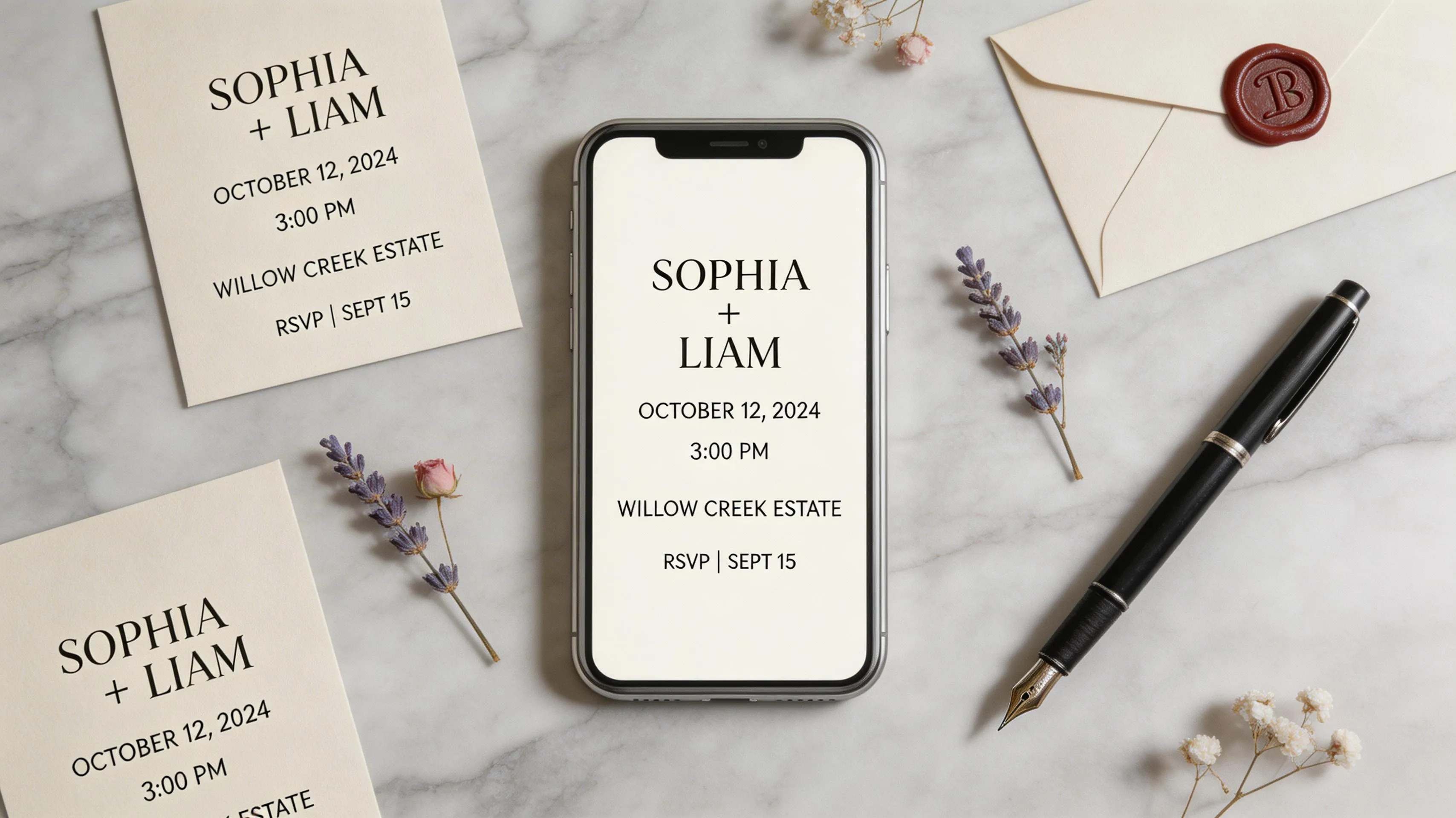
Choosing between digital and paper wedding invitations is one of the first big decisions couples face when planning their wedding. Both options have distinct advantages, and the right choice depends on your budget, timeline, guest demographics, and personal style. According to The Knot's 2025 Real Weddings Study, the average couple spends $590 on wedding stationery alone — and that number climbs fast once you add save-the-dates, RSVP cards, and extra inserts. This guide breaks down every factor so you can make the best choice for your celebration. A digital wedding invitation is an online invitation that couples create and share via a link. Guests open it on any device to view the invitation, RSVP, and access event details. Unlike the plain email invitations of ten years ago, modern digital invitations feature professional templates with video backgrounds, animations, countdown timers, and interactive RSVP forms — delivering an experience that rivals or exceeds traditional paper stationery. It's not a downgrade; for many couples, it's genuinely the better option.
How Much Do Digital Wedding Invitations Cost vs Paper?
Paper Invitation Costs
Paper invitations typically cost between $2 and $10 per invitation when you factor in design, printing, envelopes, and postage. For a wedding with 150 guests, that adds up to $300–$1,500 or more for premium stationery. This does not include save-the-date cards ($150–$400), RSVP cards and return envelopes ($100–$300), menu cards, or place cards. According to a WeddingWire survey, many couples spend $500–$2,000+ on their complete paper stationery suite. And if you need to make a correction after printing — a misspelled name, a venue change — you pay for a full reprint.
Digital Invitation Costs
Digital wedding invitations are dramatically more affordable. With SaidVows, plans start at $10 for up to 200 guests — a single one-time payment with no per-guest pricing, no subscription fees, and no hidden costs. The Premium plan at $29 includes unlimited guests, all templates, multilingual support, and QR codes. Even the top-tier Luxury plan at $79 costs less than most basic paper suites. Plus, save-the-dates, RSVP tracking, and guest management are all included — no separate purchases needed. You could literally pay for the Luxury plan and still have hundreds of dollars left over compared to a mid-range paper suite.
Which Is Faster: Digital or Paper Invitations?
Paper Timeline
Paper invitations follow a rigid timeline that demands months of planning. Couples typically start the design process 4–6 months before the wedding. After selecting a designer or stationery vendor, proofing takes 1–2 weeks, printing takes another 2–4 weeks, and addressing envelopes by hand adds another week. Once mailed, delivery takes 3–7 business days. The entire process from concept to mailbox is often 8–12 weeks. If anything goes wrong — a typo, a vendor delay, a postal hiccup — you're scrambling.
Digital Timeline
Digital invitations can be created and sent in under 20 minutes. Choose a template, add your wedding details, customize colors and fonts, and publish. Your invitation is live immediately with a single shareable link. If you need to update a venue address or change the time, you simply edit the invitation and save — your guests always see the latest version through the same link. No reprinting, no re-mailing, no additional cost. That kind of flexibility just doesn't exist in the paper world. Even if you are months ahead of schedule, the digital approach still saves you time — paper invitations require coordinating with designers, printers, and calligraphers, each adding their own lead time and revision cycles. With SaidVows, you control the entire process yourself. Make a change at midnight on a Sunday? Done. No waiting for business hours, no revision fees, no back-and-forth emails. That level of autonomy is liberating, especially during an already stressful planning period.
How Do Digital Invitations Make RSVP Tracking Easier?
With paper invitations, RSVP tracking is a manual and often frustrating process. You include a response card and stamped return envelope with each invitation, wait weeks for responses, then manually enter each reply into a spreadsheet. Some guests forget to respond entirely, requiring follow-up calls. You end up juggling multiple spreadsheets, text messages, and sticky notes to piece together your final headcount. It's the kind of organizational headache nobody warns you about during engagement parties. Digital invitations solve this completely with built-in RSVP forms where guests can confirm attendance, select meal preferences, note dietary restrictions, add plus-ones, request songs, and leave personal messages — all tracked in a real-time dashboard automatically. Automatic reminders can be sent to guests who haven't responded, and the entire guest list can be exported as a CSV file for your caterer or wedding planner. No more chasing people down or decoding illegible handwriting on response cards.
What's the Guest Experience Like with Digital Invitations?
Modern digital invitations are nothing like the plain email invitations of the past. Platforms like SaidVows offer animated templates with video backgrounds, countdown timers, interactive maps, background music, and photo galleries. Guests receive a link that works on any device — phone, tablet, laptop — and can RSVP in seconds without needing a stamp or mailbox. The experience is instant, visual, and actually kind of fun. Several guests have told us they showed the invitation around at work because it looked so good. Sharing is seamless too — distribute your link via WhatsApp, email, Instagram, Facebook, SMS, or any messaging app. Generate a QR code for physical save-the-date cards or venue signage. One link, one source of truth, accessible from anywhere — particularly valuable for destination weddings or international guest lists where postal mail would take weeks to arrive and cost a fortune in international stamps.
Are Digital Wedding Invitations Better for the Environment?
A 150-guest wedding can easily produce 1,000+ pieces of printed material from invitations alone: save-the-dates, invitations, RSVP cards, envelopes, inner envelopes, tissue paper, and menu cards. When you add the carbon footprint of printing, shipping, and postal delivery, the environmental cost is real. According to Brides, the wedding industry generates significant paper waste annually, and invitations are one of the easiest areas to reduce your footprint. Digital invitations eliminate this entirely — zero paper, zero postage, zero waste. The environmental math is straightforward: a typical paper suite uses about 30 grams of paper per guest, totaling 4.5 kilograms for 150 guests before you factor in misprints and extras. Add printing presses, ink production, and postal delivery trucks making 150 separate stops, and the impact adds up quickly. A digital invitation requires only the energy to load a webpage. If every couple getting married this year chose digital over paper, the savings would be measured in thousands of metric tons.
When Does Paper Still Make Sense?
Paper invitations remain a wonderful choice for very formal weddings where physical stationery is part of the aesthetic — letterpress printing, wax seals, ribbon details. They also work well for older family members who prefer something tangible. As Emily Post's etiquette guide notes, formal invitations carry a sense of ceremony that some couples and families deeply value. There's nothing wrong with wanting that — tradition exists for good reasons. A popular hybrid approach is to send digital invitations to most guests and reserve paper for parents, grandparents, or VIP guests. SaidVows generates QR codes you can include in physical cards, bridging both worlds with a single link. You get the best of both without doubling your budget or your workload.
How the Hybrid Approach Works in Practice
The hybrid model is more popular than most people realize. Here is how it typically works: create your full digital invitation on SaidVows with all the details, RSVP form, and interactive features. For the 10–15 guests who would appreciate something physical — grandparents, elderly aunts, your partner's traditional parents — order a small batch of simple printed cards (even a nice card from a local printer works) and include the QR code that SaidVows generates. The QR code links directly to your digital invitation. Those guests get the physical keepsake they value while still accessing the digital RSVP and all the interactive features. The remaining 130+ guests get the digital link directly. Total cost: maybe $50 for the printed cards plus your SaidVows plan, instead of $500–$1,500 for a full paper suite.
So Which Should You Choose?
For most modern couples, digital wedding invitations offer the best combination of cost savings, convenience, and guest experience. They're faster to create, easier to manage, better for the environment, and include features like RSVP tracking that paper simply cannot match. With 65+ professionally designed templates, real-time RSVP tracking, multilingual support, and one-time pricing starting at $10, SaidVows makes it easy to create something beautiful — and share it with everyone you love in minutes, not months.
Quick Comparison Checklist: Digital vs Paper
Still weighing your options? Here's a rapid-fire comparison to help you decide. Cost: digital saves $300–$1,400 on average compared to a full paper suite. Speed: digital takes 20 minutes from start to guest inbox versus 8–12 weeks for paper. Editing: digital lets you update details instantly at no extra cost, while paper requires a full reprint for any correction. RSVP tracking: digital provides a real-time dashboard with automated reminders, whereas paper means manual spreadsheet entry and follow-up phone calls. Environmental impact: digital produces zero waste, while paper generates over four kilograms of material for a 150-guest wedding. Guest experience: digital offers interactive maps, video backgrounds, countdown timers, and music — paper offers tactile elegance and tradition. The only scenario where paper consistently wins is a very formal, black-tie affair where the physical invitation is part of the aesthetic statement. For everything else, digital delivers more value at a fraction of the cost and effort.