Multilingual Wedding Invitations: One Link, Every Language
Planning a multicultural wedding? Create a single digital invitation that speaks every guest's language with a built-in language switcher — no separate versions needed.
Key Takeaways
- Multilingual invitations ensure every guest feels included and informed
- Support right-to-left languages like Arabic and Urdu natively
- A built-in language switcher lets guests choose their preferred language
- Prioritize languages spoken by the majority of your guest list
Posted by
 Marwan
Related reading
Islamic Wedding Invitations: Honoring Tradition in a Digital World
How to create an Islamic wedding invitation (Nikah) that respects cultural traditions while embracing modern convenience. Templates, wording, and etiquette.
Multicultural weddings are becoming the norm, not the exception. When one side of the family speaks French and the other speaks Arabic, or when the couple speaks English but the grandparents don't, the invitation becomes a language puzzle. With paper, you'd need to print separate versions — doubling the cost and the confusion. According to The Knot, nearly one in three weddings today involves partners from different cultural backgrounds, and that number is rising every year. The invitation is often the first place where those two worlds meet. The traditional solution — printing separate invitations in each language — is expensive, logistically painful, and creates confusion about which version is the “official” one. Did we update the venue address on both versions? Does the Arabic version have the same RSVP deadline as the English one? With a single digital invitation that supports multiple languages, these coordination headaches disappear completely. One invitation, one link, one source of truth — but in as many languages as your guest list requires. You make a change once, and it appears in every language version instantly.
How Do Multilingual Digital Invitations Actually Work?
SaidVows's Premium and Luxury plans include a built-in language switcher. Here's how it works in practice: you write your invitation content in your primary language, then add translations for each section. When a guest opens the invitation, they see a small toggle at the top. They tap their preferred language, and the entire invitation — names, dates, venue, RSVP form, everything — appears in that language. One link, no separate invitations, no confusion. The toggle is intuitive enough that we've seen 80-year-old grandparents use it without help. It's a flag icon, they tap it, and suddenly everything is in their language. No app downloads, no account creation, no instructions needed.
How Many Languages Can You Add?
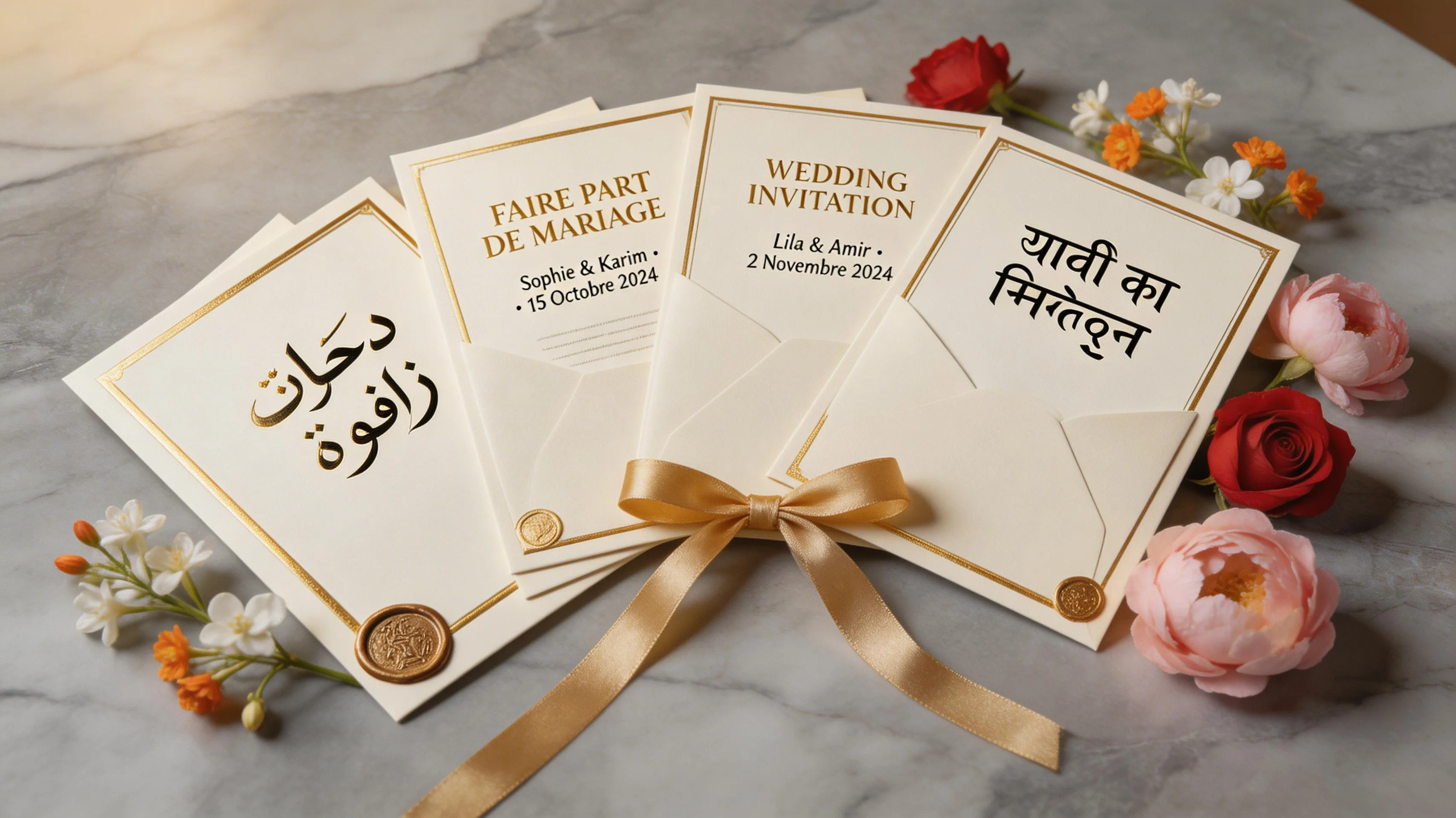
There is no hard limit on the number of languages you can include in a single SaidVows invitation. We have couples running invitations in two, three, and even four languages simultaneously. A Lebanese-French couple recently created an invitation in Arabic, French, and English — covering every branch of both families with one link. Each language version maintains its own formatting, so Arabic reads right-to-left while French and English read left-to-right, all within the same template. The system remembers each guest's language preference too, so if they revisit the invitation later, it opens in the language they last selected. Small touches like that make the experience feel genuinely polished rather than bolted on as an afterthought.
Why Does Language Choice Matter So Much at Weddings?
An invitation in someone's native language isn't just convenient — it's a gesture of respect. When your partner's grandmother sees the invitation in her language, it says “we thought of you specifically.” That matters, especially at a wedding where two families are coming together for the first time. It's the difference between feeling like a guest and feeling like family. We've had couples tell us that the multilingual invitation was the first thing that made their partner's parents feel truly welcomed into the planning process. We've seen this across couples who mix Arabic and English, French and Turkish, Spanish and Dutch, Hindi and English, and many more combinations. The multilingual toggle gets mentioned in almost every piece of feedback we receive — it's a small feature with a big emotional impact. As Brides magazine notes, making both families feel included from the very first communication sets the tone for the entire celebration. It's not just about translation; it's about belonging.
The Cost of Getting Language Wrong
Consider the alternative: sending an English-only invitation to guests who primarily speak Arabic or Spanish. At best, they struggle through it. At worst, they miss important details — the venue address, the dress code, the RSVP deadline — because they couldn't fully understand the text. We've heard stories of guests showing up on the wrong day because they misread a date written in an unfamiliar language. That's not a minor inconvenience; it's a missed celebration. When you provide the invitation in each guest's native language, you eliminate that risk entirely. Everyone gets the same information, presented in a way they can fully understand and appreciate. The emotional impact is real, but so is the practical benefit.
How Does SaidVows Handle Right-to-Left Languages Like Arabic?
Arabic, Urdu, and Farsi are right-to-left (RTL) languages. Most digital platforms handle RTL text poorly — reversed layouts, broken alignment, garbled formatting. Our templates are designed from the ground up to support bidirectional text correctly. When a guest switches to Arabic, the entire layout mirrors correctly, including text alignment, decorative elements, and reading flow. Calligraphy stays crisp, geometric patterns maintain their symmetry, and the overall experience feels natural rather than like a broken English page displayed backwards. This is particularly important for Islamic wedding invitations, where Arabic calligraphy is not just text but an art form. A Bismillah rendered in beautiful Thuluth script needs to display perfectly at every screen size — from a 6-inch phone to a 27-inch monitor. Our rendering engine treats Arabic calligraphy as a first-class design element, not an afterthought that gets squished or stretched when the viewport changes. If you're planning an Islamic wedding with guests across multiple countries, check out our dedicated guide to Islamic wedding invitation traditions for more on how to honor cultural and religious customs digitally.
What Are the Most Popular Language Combinations?
Based on our data, the most common multilingual pairings on SaidVows are Arabic and English, Arabic and French, Turkish and English, Spanish and English, and Hindi and English. But we also see beautiful combinations like Malay and Arabic for Malaysian Muslim weddings, Dutch and Turkish for couples in the Netherlands, and Portuguese and English for Brazilian-American celebrations. The system supports any language that can be typed on a keyboard, including CJK (Chinese, Japanese, Korean) characters and Devanagari script. If your family speaks it, your invitation can too. There's no list of “supported languages” to check — you simply type in whatever language you need.
What Are the Best Practices for Translating Your Invitation?
- Don't use Google Translate for your wedding invitation. Seriously. Ask a native speaker to review — machine translation misses cultural nuances that matter deeply at weddings.
- Keep each language version at a similar length to maintain layout balance
- Some cultural references don't translate — adapt, don't just translate literally. “Dinner and dancing to follow” might need a completely different phrasing in Arabic.
- Test the invitation in each language before publishing, especially for RTL scripts
- Have someone from each language group preview the invitation on their phone before you send it widely — they'll catch tone issues a translator might miss
Pro tip: start with the language you're most comfortable writing in, then translate outward. Most couples write the English version first and then work with family members on the Arabic, French, or Spanish versions. This ensures the primary content is polished before translation begins. If you're not sure about a particular phrase, ask your partner's family directly — they'll appreciate being involved, and you'll get phrasing that sounds natural rather than textbook-correct but emotionally flat.
Common Mistake: Translating Names
One issue that catches couples off guard is name transliteration. “Ahmad” in English might be “Ahmed” in Turkish or “أحمد” in Arabic. Make sure you use the correct spelling of each name in each language version. This is especially important for the host line — getting a parent's name wrong in their own language is a faux pas you really want to avoid. Our editor lets you customize names independently per language, so the Arabic version can use the Arabic spelling while the English version uses the Latin transliteration.
One more thing worth mentioning: the RSVP form translates too. That means your Arabic-speaking uncle isn't struggling through an English form trying to figure out what “dietary restrictions” means. Button labels, placeholder text, and confirmation messages all display in the selected language. Every touchpoint feels native, from the first glimpse of the invitation to the final RSVP confirmation screen. This attention to detail is what separates a truly multilingual experience from a superficially translated one. Ready to create your multilingual invitation? Our Premium and Luxury plans include full multilingual support with unlimited languages. If your guest list spans two or more languages, multilingual invitations are not a luxury — they are a necessity. Every guest deserves to receive your wedding invitation in a language they fully understand, and with SaidVows, providing that is as simple as adding a translation and publishing. One link, every language, every guest feeling welcomed and included from the very first moment they open your invitation. That is the power of a truly multilingual digital invitation — it does not just translate words, it translates warmth.
How Do You Involve Family Members in the Translation Process?
Translation is not just a logistical task — it is an opportunity to bring both families into the planning process. Ask your partner's mother to review the Arabic version. Invite your French-speaking aunt to polish the phrasing. When family members see their language treated with care on the invitation, they feel ownership over the celebration in a way that transcends cultural boundaries. Practically speaking, shared review also catches errors that automated tools miss: a formal Arabic greeting where a warm one is expected, a French idiom that sounds stiff when translated literally, or a name spelling that differs between language conventions. Create a simple review workflow — draft the translation, share it with one trusted native speaker per language, incorporate their feedback, and publish. The whole process adds maybe an hour to your preparation time, but the goodwill it generates with both families is immeasurable. Your invitation becomes a collaboration, not just an announcement, and that collaborative spirit sets a beautiful tone for the marriage itself.